

Reviewed by Anthony Perry, CPCU, high-net-worth risk management specialist at PCRG Insurance. Last updated October 2026.
What does personal cyber insurance do for high-net-worth families?
Personal cyber insurance helps pay for losses when cybercrime reaches your family. That can mean a wire sent to a fake attorney, a criminal threatening to leak your family’s private files unless you pay, or a stolen identity that takes months to untangle, plus the experts who help you recover. For high-net-worth families, it covers the losses that homeowners and umbrella policies usually leave out.
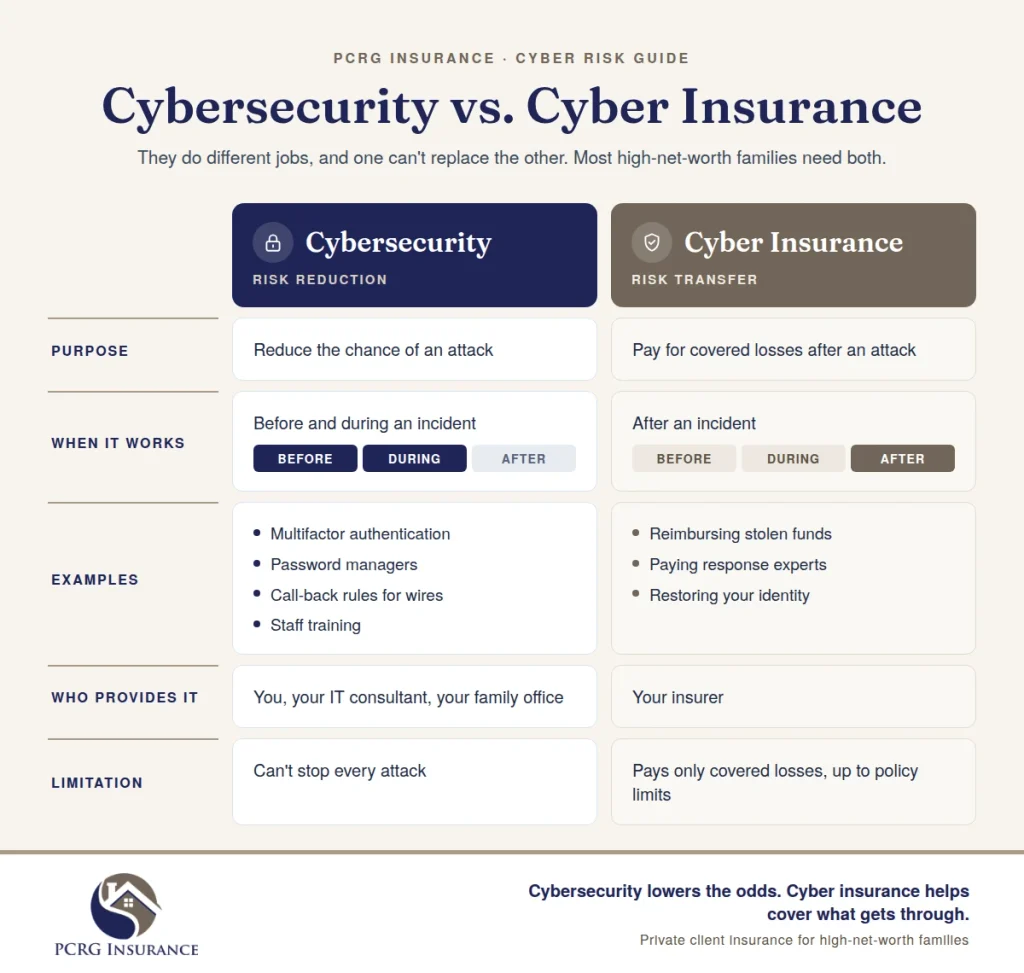
It doesn’t replace good security, though. Cybersecurity lowers the odds of an attack, and cyber insurance helps pay for what still gets through.
Key takeaways: personal cyber insurance at a glance
- Americans lost nearly $21 billion to cyber-enabled crime in 2025, according to the FBI, across more than a million complaints.
- Homeowners policies may include some cyber coverage, but it’s usually limited and easy to outgrow.
- Umbrella policies cover your liability to others. They generally don’t reimburse money stolen from you.
- The right limit depends on your accounts, properties, staff, and how often large sums move through your household.
- Cyber coverage works best when it’s reviewed alongside the rest of your insurance program.
Why do cybercriminals target high-net-worth families?
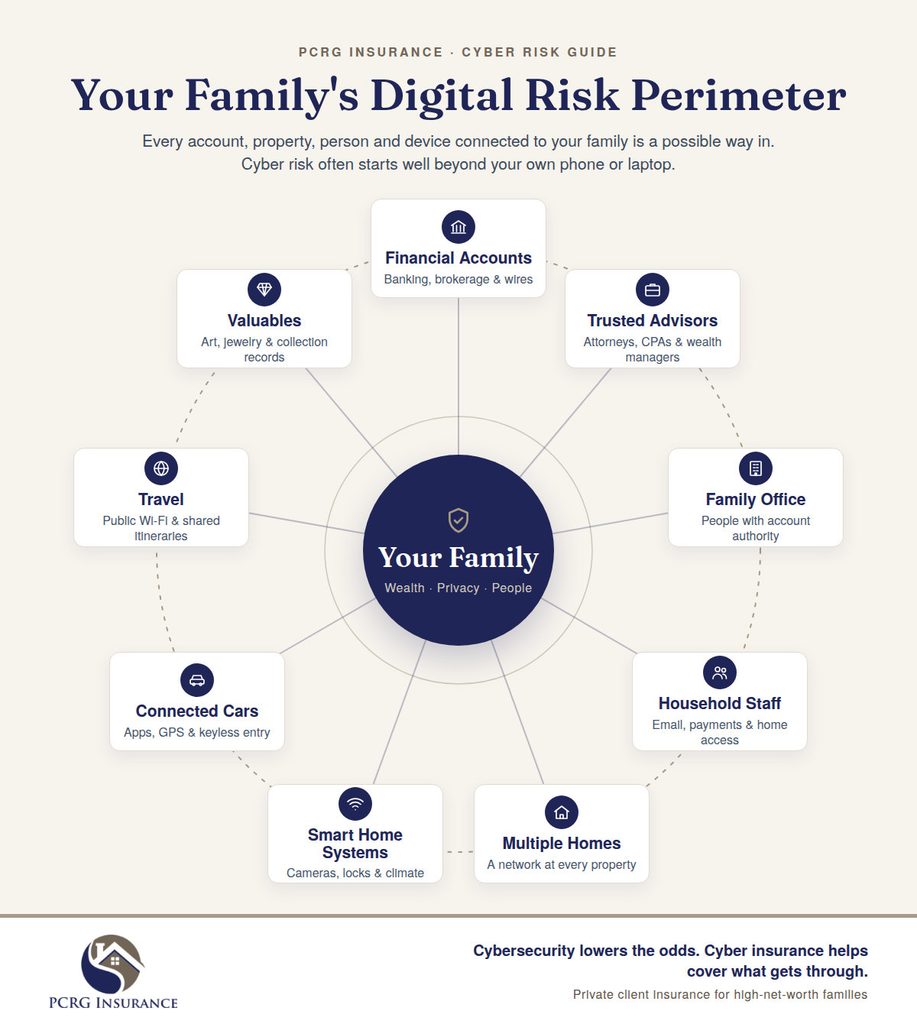
Criminals go where the payoff is biggest. A wealthy household usually has more accounts and properties than most. It may also have household staff, a family office, and outside advisors, and each of those relationships is another way in.
The numbers are moving in the wrong direction. Reported losses in 2025 beat the prior year’s record of $16.6 billion by 26%. Business email compromise, where criminals impersonate someone you trust to redirect a payment, accounted for about $3 billion of that total. Americans over 60 reported roughly $7.7 billion in losses, a 59% jump from 2024. Artificial intelligence is making scams more convincing too. The FBI tracked AI-related crime for the first time in 2025 and logged more than 22,000 complaints tied to over $893 million in losses.
Here’s how it can happen. A family is closing on a $2 million vacation home when an email arrives that looks exactly like it came from their attorney, with “updated” wiring instructions. They wire the $400,000 down payment, and within hours the money is gone. No one’s computer was hacked. The weak point was one email nobody verified by phone.
This scam is called business email compromise, a type of social engineering fraud. It’s exactly the kind of loss that homeowners policies rarely cover and personal cyber policies are designed to address.
What is personal cyber insurance?
Personal cyber insurance is a policy that pays for certain losses individuals and families suffer from cybercrime. It also pays for the specialists who help them recover. It’s separate from the commercial cyber coverage businesses buy.
For high-net-worth families, it usually sits inside a broader private client insurance program, next to homeowners, high-value auto insurance, umbrella, and valuable articles coverage. What’s covered, and how much, depends on the insurer and the policy.
What does personal cyber insurance cover?
Coverage varies by policy, but many personal cyber policies include some or all of the following:
- Cyber extortion and ransomware. Pays for experts to respond to a ransom demand and, where the policy allows, the cost of resolving it.
- Online fraud and social engineering. Reimburses money stolen through a fake invoice, a spoofed email, or an impersonated advisor. This often carries its own lower limit, so check it closely.
- Identity theft restoration. Covers the cost of restoring your credit and accounts, and sometimes lost wages and legal fees.
- Data and device restoration. Pays to recover files and clean or replace infected computers, phones, and smart home systems.
- Cyberbullying and online harassment. Some policies pay for counseling, temporary relocation, or legal help if a family member is targeted.
- Privacy and reputation support. Some policies help with removing harmful content online or cover public relations help after a data leak.
- Liability to others. Covers claims if malware spreads from your devices to someone else’s, or if you accidentally expose another person’s private data.
What does personal cyber insurance not cover?
Personal cyber insurance usually doesn’t cover business losses, events that happened before your policy started, or losses another policy already pays for. Exclusions vary by insurer, but these are the most common:
- Business-related losses. Losses tied to a business, side venture, or family office typically need separate commercial cyber coverage.
- Prior or known incidents. A breach or scam that started before your coverage began, or that you knew about when you applied, is generally excluded.
- Losses covered by another policy. If homeowners, crime, or another policy already responds, cyber coverage may pay only the remaining amount, or nothing.
- Cryptocurrency and digital assets. Many policies exclude or tightly limit stolen crypto, NFTs, and other digital currency.
- Intentional or dishonest acts. Losses caused on purpose by you or a covered family member aren’t covered.
- Missed security requirements. If the policy requires multifactor authentication, backups, or callback verification for wires and those steps weren’t followed, a claim may be reduced or denied.
- Investment and market losses. Coverage generally doesn’t pay for lost investment value, missed opportunities, or the market value of stolen data.
- Widespread outages and acts of war. Failures of power, internet, or other infrastructure, and attacks tied to war or state actors, are commonly excluded.
- Upgrades beyond restoration. The policy pays to restore devices and systems to how they were, not to upgrade them.
Always read the exclusions and definitions sections of your policy together. A single word such as “voluntary transfer” or “business pursuit” can decide whether a claim is paid. PCRG Insurance can walk through that wording with you before you need to file a claim.
Does homeowners insurance cover cyber risks?
Sometimes, but usually not by much. Many homeowners insurance policies either exclude cyber losses or include a small cyber or identity theft endorsement with a modest limit. For most high-net-worth families, that isn’t enough.
Does homeowners insurance cover identity theft?
Often, yes, as an add-on or a built-in service. It typically reimburses the cost of restoring your identity, such as notary fees, legal help, and lost time from work. It usually doesn’t cover stolen funds.
Does homeowners insurance cover online or wire fraud?
Rarely in a meaningful way. If a scammer tricks you into wiring money, a standard homeowners policy is unlikely to reimburse it. A dedicated personal cyber policy is more likely to address it, though often with a separate limit.
Does umbrella insurance cover cyber risks?
Usually not for your own losses. An umbrella policy adds liability protection above your home and auto coverage. It’s built to pay when you’re responsible for harm to someone else, not when money or data is taken from you.
Some umbrella policies may respond to certain cyber-related liability claims, but that depends on the policy wording. It’s safest to review your homeowners, umbrella, and cyber coverage together rather than assume one fills the other’s gaps.
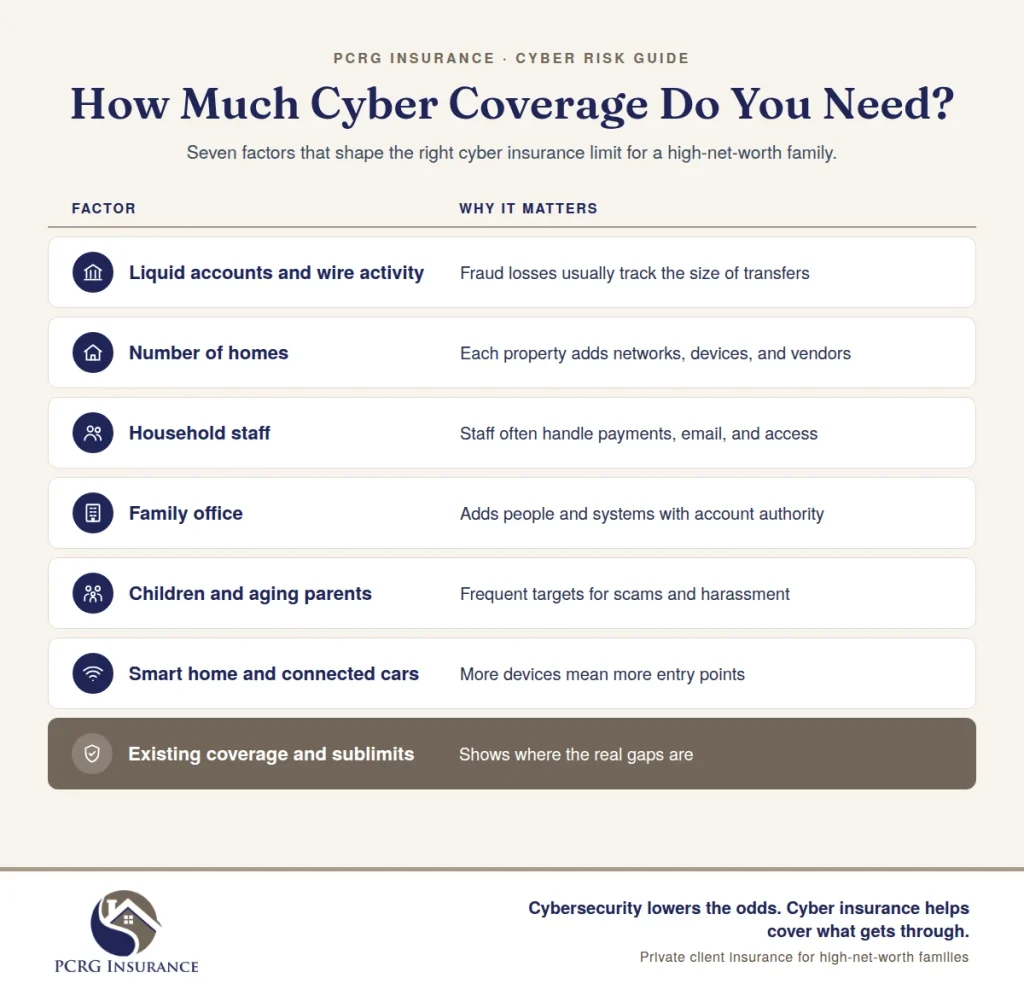
How much cyber insurance does a high-net-worth family need?
Enough to cover the largest loss you could realistically suffer, and for many high-net-worth families that’s more than a basic policy offers.
A simple way to start sizing your limit:
- Find your biggest single transfer. What’s the largest wire your household sends in a typical year, such as a home closing, tuition, or a capital call? Fraud losses often match one transaction.
- Count the doorways. More properties, staff, family members, and advisors mean more ways in.
- Check your sublimits. A high overall limit doesn’t help if fraud coverage is capped far lower.
- Look at what you already have. Existing homeowners endorsements or identity services may overlap.
Cybersecurity vs. cyber insurance: what’s the difference?
Cybersecurity lowers the chance of an attack. Cyber insurance pays for certain losses after one. You need both.
How to review your family’s cyber insurance coverage
Review your coverage in five steps:
- Gather your policies. Pull your homeowners, umbrella, and any cyber or identity coverage. Example: you may have a $25,000 identity endorsement you forgot about.
- Find the sublimits. Check the exclusions, deductibles, and conditions. Example: a $1 million policy may cap wire fraud at $100,000.
- Map your exposure. List your accounts, properties, staff, advisors, and devices. Example: a caretaker using your home office computer adds risk.
- Compare coverage to exposure. Example: a $50,000 fraud sublimit leaves a $450,000 gap on a $500,000 closing wire.
- Review it all together. Cyber risk overlaps with property, liability, and valuables coverage.
Questions to ask your insurance advisor about cyber coverage
- Do my homeowners or umbrella policies include any cyber coverage?
- What is my limit for wire fraud and social engineering?
- Are ransomware, cyberbullying, and cryptocurrency losses covered?
- Are household staff, family office systems, and family members who live elsewhere covered?
- What security steps does the policy require, such as multifactor authentication?
- What is my deductible, and does it apply per incident?
The 5-step family cyber risk plan: where insurance fits
Cyber insurance is the last step in a five-part plan, not the first:
- Prevention: Strong passwords, multifactor authentication, secure devices, and trained staff.
- Detection: Account alerts and monitoring that catch problems early.
- Response: A written plan for who to call and what to do in the first hour.
- Recovery: Restoring accounts, data, devices, and your identity.
- Risk transfer: Insurance that pays for the covered losses that remain.
Families who do the first four well usually face smaller, less frequent losses. The fifth step protects them when something still gets through.
Personal cyber insurance FAQs
Is personal cyber insurance worth it for high-net-worth families?
For most, yes. Wealthy households face larger potential losses from fraud and extortion, and homeowners and umbrella policies typically leave those losses uncovered or only partly covered.
Does cyber insurance cover wire fraud?
Many personal cyber policies cover social engineering fraud, including redirected wires, but often with a separate, lower limit. Confirm the exact amount in your policy.
Does cyber insurance cover my household staff?
It depends on the policy. Some extend coverage to losses involving domestic employees; others don’t. Ask your advisor to confirm.
What’s the difference between personal and commercial cyber insurance?
Personal cyber covers individuals and families. Commercial cyber covers businesses. If you run a family office or business, you may need both.
Do Cyber Insurance Policies Require Multifactor Authentication?
Some do. Insurers may ask about multifactor authentication, backups, or wire verification procedures, and coverage can depend on meeting those conditions.
How much does personal cyber insurance cost?
Premiums depend on the insurer, limits, household size, and your security practices.
Protect your family’s wealth and privacy online
Your family’s wealth, homes, and privacy now live partly online. Protecting them takes more than antivirus software or a single policy. It takes good habits and the right coverage working together.
Your family’s accounts, homes, and personal information are more connected than ever, and a single gap in coverage can be costly. The best time to find that gap is before a claim, not after.
PCRG Insurance is an independent agency, so we’re not tied to any one insurer. We shop multiple high-net-worth carriers to find coverage that fits your family, and we review cyber risk alongside your home, auto, umbrella, and valuables coverage, not in isolation.
Get a complimentary cyber coverage review. Tell us a little about your household, and we’ll compare your current coverage against your real exposure. If you have your declarations pages handy, upload them with your request so we can review your exact limits.
Prefer to speak directly with an agent? Call (425) 243-5193
Serving Washington, Oregon, Utah, California, Idaho, Arizona, Colorado, Nevada, Illinois, Ohio, Montana, Tennessee, Wyoming, Missouri, Oklahoma, Connecticut, Rhode Island, and Texas.
This article is for general information only and is not legal, technical, or coverage advice. Coverage depends on the terms, conditions, and exclusions of each policy.